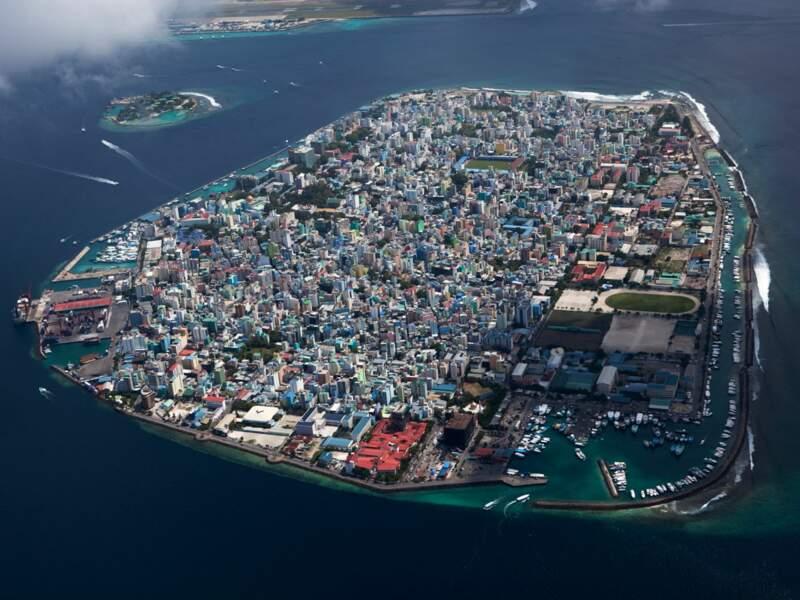
 Malé, the capital of the Maldives.
The 600,000 tourists who arrive each year in the luxury hotels are unaware of this: the archipelago is a young democracy with many worries.Photos by Pascal Maitre - Texts by Hania Luczak Discover the report in the Maldives Find the whole report in the magazine GEO n°387 (May 2011)Photo 1 / 12 - Malé, the capital of this Indian Ocean archipelago, is only protected from the waves by a concrete dike. The whole country is on the water's edge and therefore particularly vulnerable to rising sea levels.Next photo: The Mandela of Asia

Mohamed Nasheed, President of the Maldives, visiting Kamadhoo on Baa Atoll.
Photo 2 / 12 - President Mohamed Nasheed, elected in 2008, has been dubbed the "Mandela of Asia". Mohamed Nasheed, 44 years old (foreground), travels around the two hundred inhabited lands, like Kamadhoo, 400 souls, on Baa Atoll. His democratic election in 2008 put an end to thirty years of dictatorship: Record density

Malé, the capital of the Maldives, is the most densely populated city in the world.
Photo 3 / 12 - Malé, the country's capital, is the most densely populated city in the world. Malé, two kilometres long, one kilometre wide and... 120,000 inhabitants. A two-room apartment rents for just over 1,000 euros a month and, on average, each flat accommodates seven people. Next photo: The prison island

Maafushi Prison Island, a two-hour boat ride from Malé, the capital of the Maldives.
Photo 4 / 12 - In the Maldives, there is the garbage island, the prison island, the detoxification island... Thus, two hours by boat from Malé, on the prison island Maafushi (photo), 540 prisoners are locked up, the vast majority for crimes and offences related to the drug trade.Next photo: Amazing

Centre for drug addicts in Himmafushi, Maldives.
Photo 5 / 12 - Himmafushi, population 1,000, is home to a treatment facility for drug addicts. The treatment lasts nine months. Cheap heroin from Pakistan and Afghanistan is ravaging the youth of the archipelago.Next photo : Toxic bomb

Aerial view of Thilafushi, the rubbish dumping island in and around Malé, Maldives.
Photo 6 / 12 - Aerial view of Thilafushi, the island where the rubbish of Malé and the region is dumped. On this garbage island, a toxic bomb in the ocean, there is a deathly silence. Even the birds have deserted. Herds of goats roam the hills of rubbish, more than 300 tons of it arriving by boat every day.Next photo: The immigrants of the garbage island

Immigrants from Bangladesh process the waste on the garbage island of Thilafushi in the Maldives.
Photo 7 / 12 - Bangladeshi immigrants process the 300 tonnes of rubbish brought from Male and the surrounding area every day to Telafushi, the refuse island. They earn only 43 euros a month, while the legal minimum wage is 114, but they earn bonuses by selling the metal they find. The rest is burnt, day and night, batteries, electrical appliances, asbestos... When the wind blows from west to east, Malé breathes in the smell of metal and dioxin. "We are going to put out this fire," promised the President of the Republic.Next photo: The kitchen parade

For the Eid festival, Utheemu's men dress in white mud and participate in the Badhije parade in the Maldives.
Photo 8 / 12 - Islam is the state religion, but each land cultivates its own rites. For the Eid festival, one of the most important in the Muslim religion, the men of Utheemu clothe themselves in white mud and take part in the Badhije parade, known as the kitchen parade: Black demons

The Dheli Maali 'demon parade' at Baarah, Haa Alifu Atoll, Maldives.
Photo 9 / 12 - As in Utheemu, on the occasion of Eid, local festivities that have little to do with Islam are organised in Baarah, on Haa Alifu atoll, the northernmost atoll in the country. For the Dheli Maali 'demon parade', the men of the village cover their skin with a paste made of black ash. Long masks hide the faces. Iron boxes filled with pebbles are fixed on sticks, drums resound, men beat the earth with their feet, as in Africa. All this while we are only 500 kilometres away from India: Traditional game
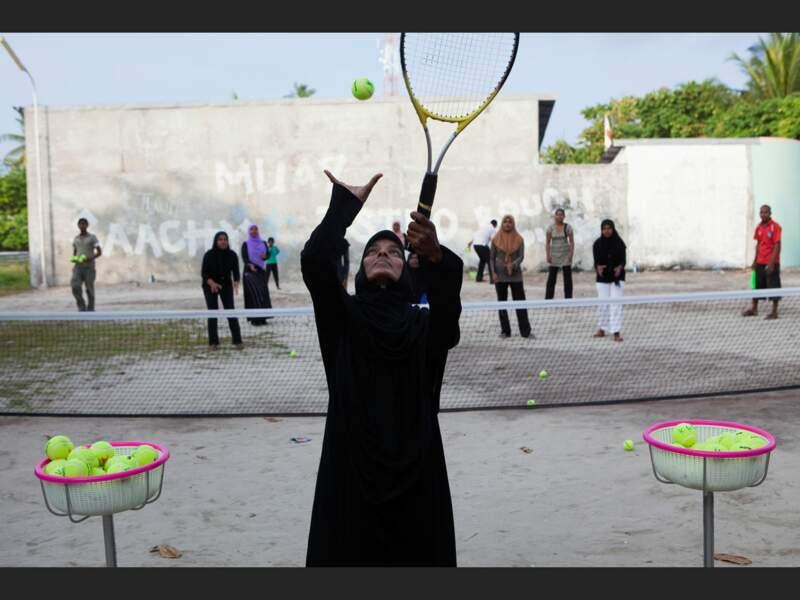
A women's bashi tournament, a traditional game, in Baarah, Maldives.
Photo 10 / 12 - On the island of Baarah, a women's bashi tournament is organised during the Eid festival. This traditional game consists of sending a tennis ball to eleven opponents, who must try to catch it.Next photo: Miracle fishing

Tuna fishing in the Maldives.
Photo 11 / 12 - Fishing here is often miraculous. In one and a half hours at night, the crew of the "Hedhey-Kuri" caught 18,000 tuna of all kinds. Their record, say the fishermen, is nine tons of fish in nine minutes.Next photo : Tourism

The swimming pool of the Holiday Inn in Malé, the capital of the Maldives.
Photo 12 / 12 - With 600,000 visitors per year, tourism is the country's main source of income. Here, the swimming pool of the Holiday Inn in Malé.back to top of slideshow