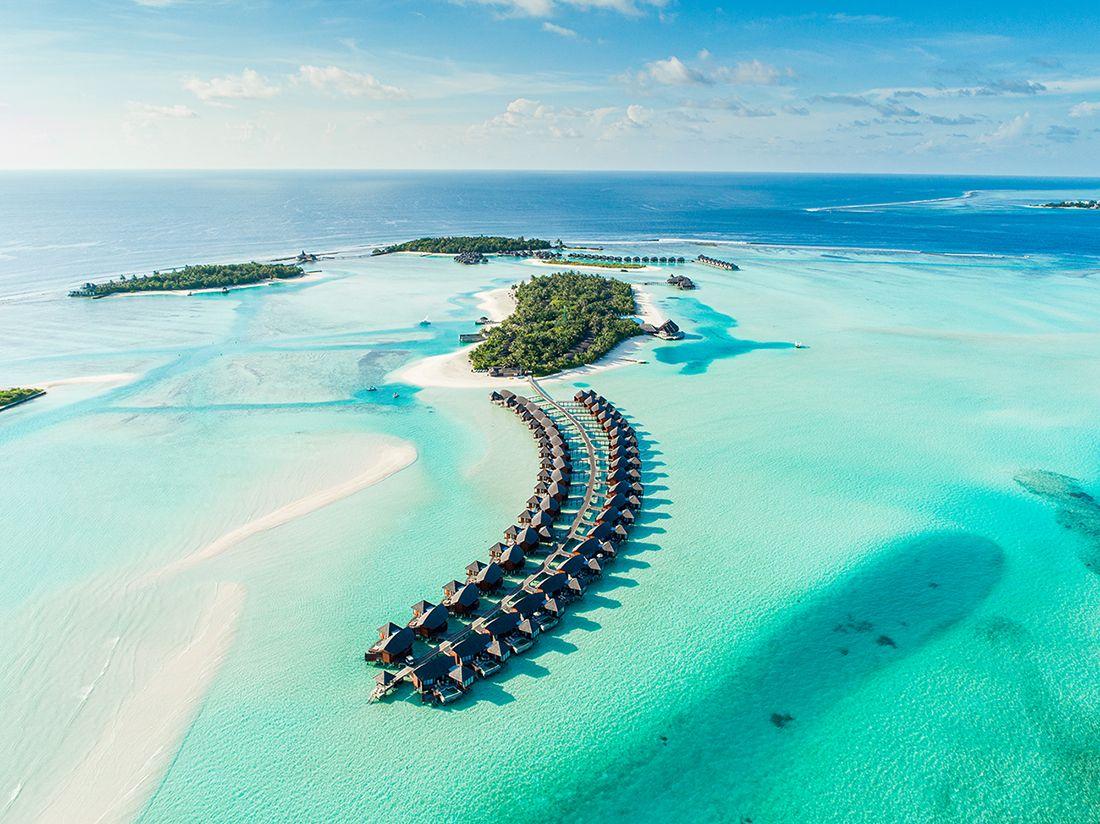
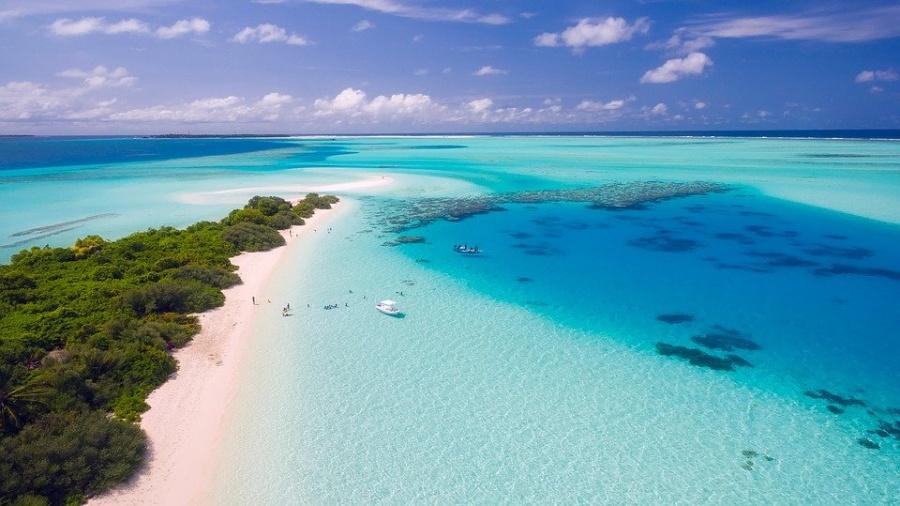
 The Maldives are an ideal destination for those who love the sea and tropical atmosphere. Located in the Indian Ocean, these islands make up one of the most beautiful archipelagos in the world. Consisting of more than 1,000 coral islands, which in turn form 26 ring-shaped atolls, the Maldives archipelago is an ideal place to relax and spend an unforgettable holiday.
Here is all the information on the climate and the best time to go to the Maldives!
Best period
Month | Average temperatures (min/max) | Precipitation (days/mm) |
|---|---|---|
January | 25 / 30° | 5 days / 90 mm |
February | 25 / 31° | 5 days / 70 mm |
March | 26 / 31° | 8 days / 80 mm |
April | 26 / 32° | 10 days / 130 mm |
May | 26 / 31° | 16 days / 210 mm |
June | 26 / 30° | 14 days / 185 mm |
July | 25 / 30° | 13 days / 160 mm |
August | 25 / 30° | 14 days / 185 mm |
September | 25 / 30° | 15 days / 215 mm |
October | 25 / 30° | 16 days / 230 mm |
November | 25 / 30° | 13 days / 190 mm |
December | 25 / 30° | 13 days / 200 mm |
Visiting the Maldives is one of those things you can do at any time of year. Here, the many hours of sunshine and the high temperature even in the 'colder' months will allow you to play sports and relax as if it were always summer. However, this also has its 'downsides', such as the fact that it is always high season in the Maldives. However, let's take a detailed look at the best time for a trip to these magnificent islands.
Northern Maldives(Kaafu Atoll, Malé): the northern atolls have constant temperatures more or less all year round, the rainy season generally runs from May to December.
Southern Maldives (Laamu Atoll, Gan): in the southern atolls you will find constant rainfall all year round. These islands, smaller and less inhabited than, are a true (almost) untouched paradise.
Considering the climatic conditions in the Maldives and the prices of accommodation, it is advisable to book when the rainy days are on the increase and the wet season is approaching. With the arrival of the 'bad weather', in fact, the price of hotels will become cheaper as most tourists come to the Maldives to exclusively enjoy wonderful days at the beach (which you will also have, despite the increasing number of rainy days).
Period to avoid
There is no 'no' period for visiting the Maldives, although you should be careful when cyclones are most frequent.
The periods most affected by their formation are the months between April and December, with two peaks in May and November. However, the southern islands are affected less by these phenomena, but they affect the Maldives in their initial phase.
Climate and seasons
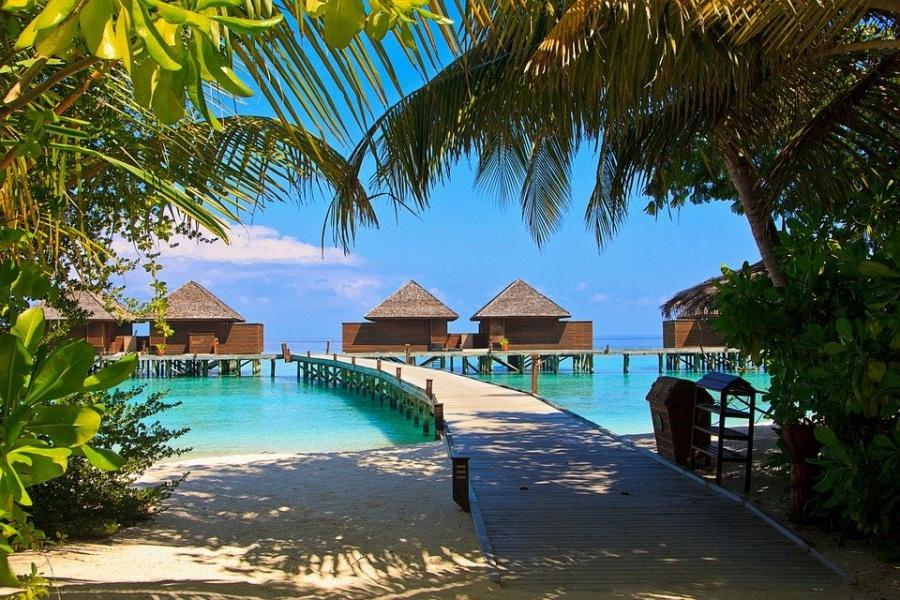 The Maldives are characterised by a typical tropical climate, influenced by the presence of monsoons. From April to September you will find monsoons blowing from the south-west, especially in the northern areas. From October to December, on the other hand, you will find the north-east monsoon, more frequent in the southern atolls, bringing rain and not too strong thunderstorms.
Temperatures are fairly stable throughout the Maldives. Highs hover around 30° while lows rarely drop below 25° all year round. The main concern is the humidity, which reaches up to 80%.
Average Temperatures and Precipitation - North Maldives (Kaafu Atoll, Malé)
Malé has a high number of hours of sunshine during the day, ranging from 8 to 9 hours in February and March. Rainfall is less frequent here than in the southern atolls, with 142 rainy days compared to 168 in Gan. Temperatures, on the other hand, are rather high with little temperature range. Between minimum and maximum temperatures there is in fact a gap of around 5°.
Recommended period: January to April
Season | Period | Temperatures (min/max) | Rainy days |
|---|---|---|---|
Dry season | January - April | 25°/32° | 28 |
Wet season | May - December | 25°/32° | 114 |
Average Temperatures and Precipitation - South Maldives (Laamu Atoll, Gan)
In the southern part of the Maldives there is not much difference in temperature compared to the northern part, but the division of the seasons changes. In fact, there is no dry season here: rainfall is evenly distributed throughout the year, resulting in a climate that is more equatorial than tropical.
Recommended period: January and February
Season | Period | Temperatures (min/max) | Rainy days |
|---|---|---|---|
Dry season | January - April | 25°/30° | 80 |
Wet season | May - December | 25°/32° | 88 |
What to pack
Region | Dry season (January to April) | Wet season (May to December) |
|---|---|---|
Northern Maldives | light clothing, sunscreen, umbrella and rubber shoes | light clothing with some more opaque and waterproof clothing for rainy days, shoes with non-slip soles |
Southern Maldives | light clothing, sunscreen, umbrella and light mackintoshes for rainy days, rubber shoes | light clothing, light mackintoshes, snorkelling equipment |
Useful info
Capital: Malé
Population: 417,492
Surface area: 300 sq km
Languages: Maldivian
Currency: Maldivian Rufyaa (MVR) / Exchange rate: €1.00 = 17.90
Documents: passport, return flight ticket and hotel reservation
Time zone: +4 h compared to Italy, +3 h when daylight saving time is in force in Italy
Vaccinations: not required