Epic desert landscapes, hospitable people and ancient ruins are the most obvious attractions in Jordan, but if you look more closely you will realise that despite its arid environment, the kingdom is also rich in lush oases, from the biblical river to salt baths and secret natural pools in the gorges. Here are eight places to discover Jordan's aquatic life.
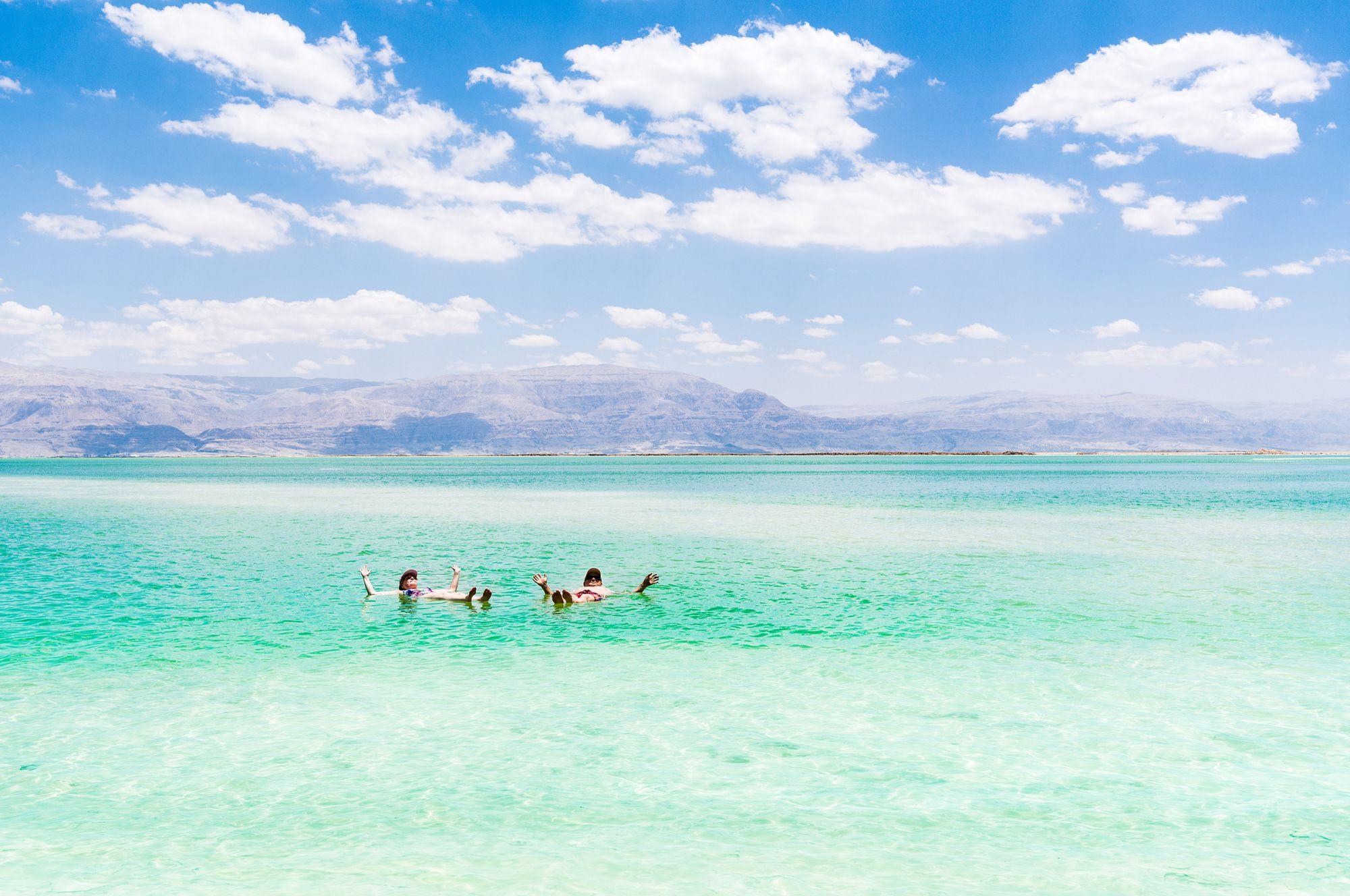
Bathing in the salty waters of the Dead Sea ©OlesyaBaron/Shutterstock
Jordan, things to see
1. Floating on the Dead Sea, the lowest point on earth
Located more than 430 metres below sea level, the Dead Sea, one of the most spectacular natural wonders on the planet, is the lowest point on the earth's surface. The seabed is even deeper and in some places goes as low as 377 metres. But you will not be able to dive to the depths: the high salinity of the Dead Sea (the salt content is 33%) will make you return immediately to the surface, not to mention that going underwater is very painful for the eyes. Instead, lie on your back, relax and float on the surface while holding a newspaper or a book. Scoop some Dead Sea mud, rich in minerals, under your feet and rub it on your body, then rinse off with a sea bath or freshwater shower.

The waters of the Ma'in hot springs absorb the desert heat © ostill / Shutterstock
2. Bathing in the hot springs of Ma'in
As you drive down the winding road through the red-brown desert mountains, the air becomes cooler and lush palm trees rise from the green valley floor. It is not a mirage, but the welcome sight of a true oasis, the hot springs of Ma'in. These natural waterfalls and hot springs, which in biblical times are said to have been King Herod's favourite place to bathe, are just as popular with 21st century visitors. The waterfalls are formed by winter rains in the highlands of Jordan and reach temperatures of over 45°C. The nearby Ma'in Hot Springs Hotel and Spa is a peaceful and rejuvenating resort that makes the most of its excellent oasis location. You can book a relaxing spa treatment and access the private thermal pool, or head to the public hot springs with the local day-trippers.

Jordan's short Red Sea coastline is a great place for scuba diving and snorkelling © ShaharShabtai / Shutterstock
3.Scuba diving adventures along the Jordanian Red Sea coastline
Snorkelling enthusiasts will have a great time in the waters of the Red Sea, where you can see moray eels, clownfish darting in and out of anemones, and colourful tropical fish swimming among the healthy coral reefs along the twenty kilometres of the Jordanian coastline. One of the best places to explore the underwater world is the Aqaba Marine Park, a marine protected area along the east coast, accessible by boat from the port of Aqaba or by land along the Beach Highway. The water temperature (25°C), good visibility and rich marine life offer ideal conditions for snorkelling all year round, although it can get very hot on land in the summer months.
4. The ancient aqueducts of Petra
In addition to being excellent merchants, the Nabataeans of Petra also had exceptional skills as hydrogeological engineers. Thanks to their acumen in managing local water systems, they were able to create valuable oases and secure economic control of the ancient incense trade route, which connected Arabia to Europe and Africa. This knowledge enabled the Nabataeans to survive and flourish in the pink city of Petra, which was also located some distance from the rivers and eight kilometres from the water source of Wadi Musa.
Walking along the Sig, the narrow gorge leading to Petra, one can still see evidence of the ingenuity of the Nabataeans: flood protection dams, terracing, canals, settling basins, aqueducts, rainwater collection systems, springs and cisterns. The canals and aqueducts dug into the rock along Sig had the task of conveying water to the heart of Petra, supplying the inhabitants of this otherwise arid land with fresh water on a daily basis.

The spectacular work of the Nabataeans at the bottom of Petra's Siq © BalintKasza / 500px
Subscribe to our newsletter! For you every week travel tips, special offers, stories from the world and 30% discount on your first order.
5. The natural pools of Wadi Al Hidan in Madaba
The development of adventure tourism in Jordan is bringing popular destinations to the fore, such as the Wadi Al Hidan in Madaba. This black basalt gorge enjoys great popularity among thrill-seeking hikers and canyoning enthusiasts, and has also become part of the Jordan Trail, a recently opened hiking trail that runs across the country. Three waterfalls, one of which offers a rock water slide, feed cool natural pools at the bottom of the narrow canyon. It is advisable to book your visit well in advance, as a limit has been placed on the daily number of visitors in order to protect this very delicate environment.
6. In the footsteps of biblical characters along the Jordan River
The Jordan River plays an important role in Judaism and Christianity, as it is believed that the tribes of Israel crossed it following Joshua and that Jesus was baptised by John the Baptist in its waters. In Bethany, beyond the Jordan, the site of the baptism, archaeologists are excavating ancient churches, ruins and caves that may have been used by John the Baptist.
Visiting the Jordan River allows the faithful on both sides of the river - Israel and the Palestinian Territories on the western side, Jordan on the eastern side - to pause for a moment of reflection, or even to experience the rite of baptism by immersion. Due to the dams and diversions built upstream, the Jordan River no longer has the width and depth it once had, and in places is more like a stream. Plan your trip in spring to take advantage of the fine weather, pleasant temperatures and the chance to admire the desert flowers and attend the Christian Easter celebrations.

Spot migratory birds in the AzraqWetlandReserve © AmeerFirdausZulkeflee / Shutterstock
7. Birdwatching in the Azraq Wetland Reserve
In the Azraq Wetland Reserve, just outside Amman, you can spot desert finches, river warblers and beaked larks. What was once a vast basin of mudflats, swamps and waterholes has shrunk over time to become a small reserve in Jordan's eastern desert. Azraq became a protected area in 1978 and is still a resting place for migratory birds travelling between Africa and Eurasia thanks to a system of artificial springs. Aim your binoculars as you walk noiselessly across the marsh on raised wooden walkways, or crouch down to spot birds without being seen.
8. Lawrence Spring in Wadi Rum
The few water springs nestled in the high cliffs of Wadi Rum, a stunning and surreal landscape, are surrounded by a red landscape reminiscent of Mars. Particularly renowned is the Lawrence Spring, located just above the village of Rum, near the ruins of an ancient Nabataean temple. The spring owes its name to the legendary English writer. T.E. Lawrence, who mentioned it in his book The Seven Pillars of Wisdom.
Stop below the spring during a camel trek or a Wadi Rum off-road tour and walk up the rocks until you reach some low trees and green shrubs after 15 minutes. As described by Lawrence, this green 'paradise only three feet wide' smells of wild mint and offers a moment of refreshment and magnificent views of the Wadi Rum desert. If you find yourself humming the notes to the soundtrack of the film Lawrence of Arabia, don't worry: finding water in the desert is always a good reason to celebrate.

A view of Wadi Rum from the Lawrence Spring © Richard Yoshida / Shutterstock
What to eat in Jordan
One of the things to do in Jordan is to drink tea with the friendly locals. Besides this, Jordanian cuisine shares several typical Arab specialities, such as falafel and hummus (both made from chickpeas). You cannot leave the country without first tasting, at least, mansaf (rice, lamb and yoghurt for what is considered the Jordanian national dish) and maqluba (again rice but this time accompanied by grilled meat and vegetables).
When to go to Jordan
The 'in-between seasons' are, without a doubt, the best times to visit Jordan. In spring and autumn, you avoid the rigours of winter and the merciless temperatures of summer. With the dutiful exception of the Red Sea, where the climate remains mild all year round.