 Basilicata is a region taken little by storm by tourists, but it has much to offer its guests. Its past is rooted in prehistoric times and this can be seen in the numerous archaeological sites in the region. Then its cuisine and folklore are rich in different influences from the various invasions it has undergone over the centuries.
From the white beaches to the turquoise sea, from villages carved into the rocks to castles perched atop silent mountains, Basilicata is this and more, and you will also be struck by the wonderful nature that frames everything.
Here we recommend 10 places you absolutely must visit.
1 - The Sassi of Matera
 The Sassi are the ancient part of Matera, i.e. some buildings and rupestrian architecture literally carved into the rock. The term 'sassi' refers to the two quarters that make up the historic centre: Sasso Caveoso and Sasso Barisano. In these quarters, one finds elegant and articulated structures alternating with underground labyrinths and caves, creating a very special landscape effect.
Visitable cave dwellings are carved into the stone of the Sassi, as well as important churches such as Santa Lucia alle Malve, the Convicinio di S. Antonio and the Church of Santa Maria di Idris. Inside the historic Palazzo Pomarici is the Museum of Contemporary Sculpture.
As the sun goes down, the lights of the houses and small businesses light up, making this fascinating UNESCO World Heritage site even more magical. If you are visiting them for the first time, you can rely on a two-hour guided tour.
2 - Maratea
Maratea is the only town in Basilicata to overlook the Tyrrhenian Sea. Its coastline stretches for more than 30 km and is characterised by inlets, caves, rocks, shoals and mostly pebbly beaches. Also along the southern stretch is the small island of Santo Janni, home to the Santo Janni Dragon, an endemic blue-brown lizard. For its scenic, artistic and historical heritage, Maratea is known as'the Pearl of the Tyrrhenian Sea'.
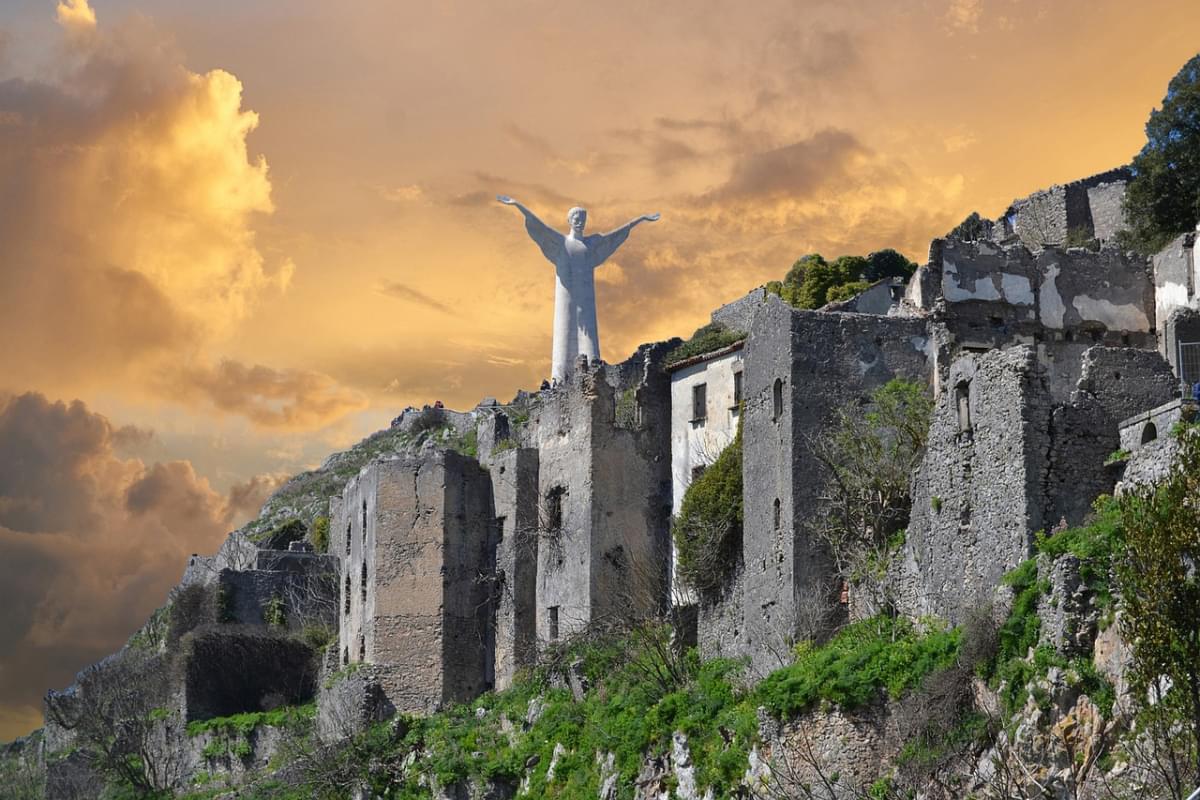
The village lies at the foot of Monte San Biagio, on whose summit stands Christ the Redeemer, the symbol of the town that towers above the historic centre. At 22 metres high, it is the tallest statue in Italy.
Among the things not to be missed is the historical centre with its intertwined alleys, flowered balconies and the many churches for which Maratea is famous. There is also the Palazzo de Lieto, which houses a permanent exhibition of underwater archaeology and various temporary exhibitions.
This Lucanian town is also a destination for trekking enthusiasts. Mount San Biagio in fact offers nature trails that, also with guided tours, allow you to reach Christ the Redeemer and the Basilica of San Biagio.
3 - Pollino National Park
Besides Basilicata, it also occupies part of Calabria, including the provinces of Cosenza, Matera and Potenza. More than 192,000 hectares of protected area make up the largest natural park in Italy, a paradise for trekking, climbing and mountain biking. The main activity within the Pollino Park is walking along the paths leading to the Piani, the Dolcedorme peaks, Serra di Crispo, and the Raganello gorges. But that's not all, in the municipality of Viggianello you can find the longest cross-country skiing track in all of southern Italy, here you are surrounded by peaks up to 2,000 metres high and immense beech forests.
Of the municipalities that make up the Pollino territory, we recommend a visit to Castelluccio Inferiore, of particular historical and archaeological interest, and San Severino Lucano, where the Sanctuary of the Madonna del Pollino is located, an important destination for a religious cult deeply rooted in the local people. But also the highest village in the park, Alessandria del Carretto in the province of Cosenza, which still preserves ancient cultural traditions.
4 - Metaponto, Policoro and Pisticci
On the Ionian coast, you can visit ancient cities of Magna Graecia, such as Policoro, Metaponto and Pisticci.
Policoro contends with Metaponto for the title of the most popular tourist resort on Lucania's Ionian coast. Between sea and archaeological finds, here you will find large sandy beaches, crystal-clear waters in which it is not at all rare to see some sea turtles, and then a short walk from the town is the archaeological site of Heraclea.
In Metaponto you can take a guided tour that passes through the Apollonio Licio Archaeological Park and ends at the Pantanello site. Don't miss the beautiful beaches here as well, low, sandy and shaded by two large pine forests.
A short distance from the Metaponto Plain is Pisticci, whose built-up area has the shape of an 'S' and forms a sort of natural amphitheatre, a characteristic for which it is called 'theamphitheatre on the Ionian Sea', but also'the balcony on the Ionian Sea', being 364 m above sea level. The historical centre of Pisticci is divided into districts, Terravecchia being the highest and oldest part, where the Castle, the old town gate, the Mother Church, the small Church of the Annunziata and the ruins of the Church of the Madonna della Stella are located.
5 - Lucanian Dolomites
 The peaks are not as high as those in the north, but the Lucanian Dolomites also offer noteworthy views. You can discover the village of Pietrapertosa on a tour to theArabata area, the historic centre and the Norman-Swabian Castle. But also Castelmezzano, famous for the Volo dell'Angelo (Flight of the Angel), a cable car that in summer allows you to 'fly' suspended in the air at a speed of 120 km/h. And if you don't have the courage for such an adrenaline-filled experience, you can always wander through the village's characteristic streets lined with white houses built into the rock and discover the rest of the historic centre.
Of great interest to climbers are the Vie Ferrate, equipped routes that allow you to reach otherwise unreachable points, and the Nepalese Bridge, which serves to connect the two starting points (Vie Ferrate Salemm in Castelmezzano and Marcirosa in Pietrapertosa).
In addition, the winter in the Lucanian Dolomites is long and enduring and satisfies all skiers with the ski resorts located in the province of Potenza. These include Monte Sirino, which remains snow-capped until late spring, and the Sellata-Arioso ski area, easily reached from Potenza.
6 - Atella Palaeolithic Park
Immersed in a natural setting where the beauty of a colourful landscape emerges unchallenged, the small town of Atella conceals the memory of a past that has its roots in very ancient times. In fact, finds have been discovered near the cemetery that testify to the presence of prehistoric settlements in the area. It is thought that probably 650-550 thousand years ago this place was inhabited by groups of homo-erectus who hunted animals and worked stone.
Today, the Palaeolithic site is located in the heart of Basilicata, near the modern municipal cemetery of Atella, and is accessible on request and free of charge. Green hills frame the site along with vineyards and olive groves.
7 - Vulture: Melfi, Venosa and Monticchio Lakes
Vulture is the name given to the northern area of Basilicata, from Monte Vulture, an inactive volcano on the border with Puglia and Campania. At the base of the mountain lies the town of Melfi, where you can discover one of Italy's most important medieval castles, the 10 towers that surround it and the beautiful village with its 11th century cathedral.
Venosa is also located in Vulture and is considered one of the most beautiful villages in Italy. Romans, Jews, Goths, Lombards, Saracens, Spaniards and many others have left their mark here; walking through Venosa is practically like walking through a history book. It is ideal to visit it with a guide during a tour of the town. Because there is so much to know about the Archaeological Park with its baths, domus, the Holy Trinity,amphitheatre and Horace's house.
But also in the enchanting scenery of Vulture are the two Monticchio Lakes, which have the highest temperature of any lake in Italy. The Lago Piccolo area is a protected reserve and habitat of an extremely rare moth that can have a wingspan of 70 mm. It is the ideal place for a relaxing trip in the midst of greenery, even for the Lucanians themselves.
8 - Ghost town of Craco
 In the province of Matera lies Craco, the ghost town abandoned since 1963 following a landslide. But in 2010 it entered the list of monuments to be safeguarded and can therefore be visited in complete safety. Tourists who come to Craco every year number in the thousands, most of them cinephiles because it has been the set of numerous films.
The inhabitants who, following the landslides and earthquakes, did not move to Craco Peschiera now reside in the new district adjacent to the old town.
In two hours you can visit the entire town together with MEC, the Craco Emotional Museum, housed in the old monastery of San Pietro and including a projection room and a digital historical, film and memory archive. It is the municipality itself that has devised the itineraries for guided tours that allow visitors to delve into the nucleus of the ghost town.
9 - Grumento Nova and Val d'Agri
To discover more of Basilicata's hidden treasures, it is necessary to go deeper inland, where there is, for example, the village of Grumento Nova. At the foot of the hill on which it stands are the remains of the ancient Roman city of Grumentum, the archaeological area of which can be visited with the Museo Nazionale dell'Alta Val d'Agri, which houses Roman, pre-Roman and Oenotrian and Magna Graecia artefacts. Also, do not miss a visit to the Sanseverino Castle and the Mother Church.
If you want to move into the wilderness, there is the perfect place, the Val d'Agri. Almost the entire territory is part of the Lucano Val d'Agri Lagonegrese Apennine National Park, it is predominantly flat and in the mountain areas hiking and skiing tourism is booming. For all Lucanians and tourists who like to ski, mountain holidays in Basilicata are a safe choice; the ski resorts are all within the Lucano Apennine Park and all in the province of Potenza. Viggiano is the most interested town, being surrounded by the highest peaks, here there are in fact Monte Volturino and Montagna Grande.
10 - Aliano and the Carlo Levi Literary Park
Lastly, a stop in Aliano is a must, since it rises up on a hill and its surrounding area is characterised by the typical landscape of calanchi (gullies). This small municipality in the province of Matera inspired Carlo Levi in the writing of the book Christ Stopped at Eboli, so much so that some of the book's symbolic phrases are engraved in the alleys. The writer spent part of his period of confinement there, and was later buried there.
An association, the Carlo Levi Literary Park, has also been set up, which with guided tours, events, food and wine and craft activities, has become a landmark in the local cultural scene. It is in fact possible to discover the landscape described by Levi by means of various itineraries on foot of varying difficulty, but also to visit with a guide the writer's house exactly as it was left by him in 1936 and his tomb.
Plan your trip: how to get there and where to stay
The closest airports to Basilicata are Naples-Capodichino and Bari-Palese; shuttles are available to reach both Matera and Potenza(flights from €10.00). Alternatively, you will have to rely on the Naples-Reggio Calabria railway line connecting Potenza with Taranto, but also the Foggia-Potenza and Taranto-Sibari. If you plan a trip to explore the region's main tourist cities, stay in Matera or Maratea, the latter also perfect for summer holidays on the Tyrrhenian coast(check out the offers).
San Severino Lucano, on the other hand, is ideal for a more relaxing stay amidst the greenery of the Pollino Park(see offers). Among the most suitable locations for a skiing holiday is absolutely Viggiano(see offers), but also Lagonegro. Basilicata is also a perfect destination for lovers of archaeology and history. Stay in the north, in Venosa(see offers) or Atella(see offers), but also in Policoro(see offers).
Related articles
Top 10 Places to Visit in Sicily in 2024
What to See in Sicily: Best Destinations and Most Beautiful Destinations
Syracuse, What to Do and See Between Sea and Beaches
6 itineraries and food and wine routes in Sicily
The Salento to see: visiting Lecce and its surroundings
Thailand's most beautiful islands: guide
Thailand: What to See? Best things to do and see at least once