The Côte d'Azur is a mythical place that has fascinated travellers of all times.
It seduced artists like Renoir, Bonnard and Picasso with its beauty and Mediterranean light. It enchants international film stars and divas, who come to the Cannes Film Festival every year.
It conquers glamour lovers heading for Monaco or Saint-Tropez, but also those who know how to go off the beaten track.
Because beyond unbridled luxury and glossy atmosphere, the Côte d'Azur also has a more authentic soul to be discovered among medieval villages, flower markets, secret coves and coastal paths along the Mediterranean.
The French Riviera, at the foot of the Maritime Alps and a stone's throw from the Italian border, is the most seductive and sunny face of France. What to see? Let's find out together.
Nice 
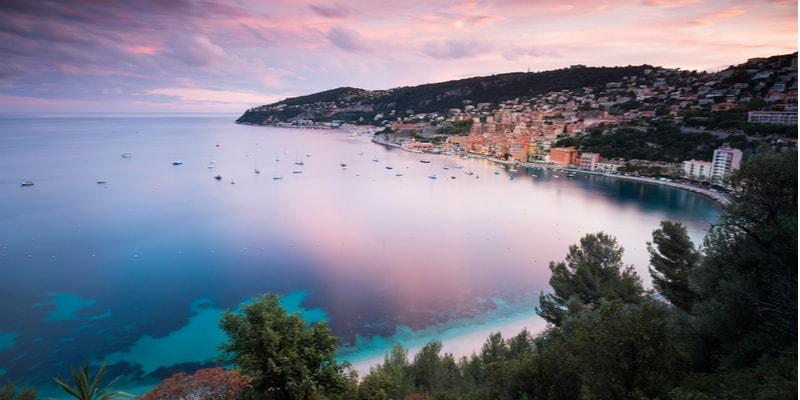
Nice is the capital of the Côte d'Azur, combining metropolitan vibrancy with the slowness of yesteryear, coupled with a year-round sunny climate and its splendid location by the sea.
The old town is a labyrinth of ancient alleys and narrow streets, bordered by the castle, the boulevard Jean-Jaurès and the cours Saleya, the main pedestrian street.
Vieux Nice was built in the 17th and 18th centuries in a simple architectural style that mainly plays with light and colour. From yellow to brick red to the green of the shutters, the old town bursts with life among its lively streets, numerous boutiques, markets and an atmosphere reminiscent of Italy.
If you love Baroque, visit the Cathédrale Sainte-Réparate, dedicated to the city's patron saint, the sumptuous 16th-century Chapelle de la Miséricorde and the 17th-century Palais Lascaris. Then don't miss a stroll along the Promenade des Anglais, the most famous promenade in Nice and all of France, which owes its name to the English residents of Nice, who financed its construction in 1822. The promenade runs all along the enchanting Baie des Anges.
But the most impressive view of Nice and its red roofs is from the Colline du Château. Art lovers will want to visit the Musée Matisse, dedicated to the famous artist buried in the cemetery of the Monastère Notre-Dame de Cimiez, but also worth a visit are the Musée Massena, built as the summer residence of Prince Victor d'Essling, and home to a museum dedicated to the history of the city and the Côte d'Azur, the Musée d'Art Moderne et d'Art Contemporain and the Musée National Marc Chagall.
Don't forget the Port Lympia with its characteristic colourful Venetian-style buildings.

A short distance from Nice is the beautiful Cap Ferrat peninsula, which closes the bay of Villefranche.
Nestled in a large pine forest where luxury villas are hidden, Cap Ferrat is a haven of peace that has always been frequented by many celebrities, such as Charlie Chaplin, Jean-Paul Belmondo, Nietzsche, King Leopold II of Belgium, Otto Preminger, Somerset Maugham and Jean Cocteau.
About 20 km from Nice, Saint-Paul-de-Vence, a wonderful medieval village with narrow streets and beautifully restored old stone houses, is also worth a visit.
It is known for its famous inn, La Colombe d'Or, which attracted the best artists of the last century. Not to be missed in the surrounding area is the Maeght Foundation with its contemporary art exhibitions.
Cannes 
Cannes is the capital of cinema and glamour. A multiform, eccentric city, of which glossy images immediately come to mind: sumptuous hotels, luxurious yachts, the hustle and bustle of Ferraris and Porsches, the world-famous Croisette.
One can hardly remain insensitive to the opulence that reaches its peak during the Festival de Cannes, usually in May.
During that time, you will see photographers on every street corner, stars posing in dinner jackets or evening gowns on the famous festival red carpet and gussied-up visitors intent on spotting celebrities stretched out on sun loungers on the most exclusive beaches or aboard yachts moored at the harbour.
But when the festival is over, Cannes returns to being a pleasant Côte d'Azur town that still holds real gems.
So discover Le Suquet, the oldest quarter of Cannes, where you can lose yourself in its narrow streets dominated by a medieval castle and the 17th-century Église Notre-Dame de l'Esperance. A splendid panorama of the bay can be admired from the ramparts. Otherwise, go to the Parc de la Croix des Gardes, the green lung of Cannes with the most beautiful mimosa forest on the Côte d'Azur, offering a 360° view of the city and the bay.
Another good reason to get away from the centre is the Californie district, the most exclusive in Cannes, located on a hill overlooking the entire bay. Here you will find exceptional villas, hidden by greenery from the gaze of the curious, such as the Villa Domergue, created by artist Jean-Gabriel Domergue, who was inspired by Venetian palaces and gardens.
You could visit the villa during the Domergue Jazz Festival in August and special evenings organised in the garden. Finally, admire the old harbour, stroll through the colourful Forville market, enjoy the richness of its cultural programme, relax on its fine sandy beaches dotted with elegant bathing establishments or get away from it all on the beautiful Lérins Islands.
A few kilometres from Cannes is Mandelieu-La Napoule, the mimosa capital and gateway to the Massif de l'Estérel, a mountain massif of volcanic origin.
Antibes 
With its delightful harbour, 16th-century ramparts and the cobbled streets of the old town, Antibes has captivated many artists and writers, including Pablo Picasso, Max Ernst and Jacques Prévert.
An entire museum is dedicated to Picasso, who portrayed Antibes in many of his paintings. It is housed in the 14th-century Château Grimaldi, used as the artist's studio from July to December 1946. Let yourself be won over by the charm of the old town, surrounded by a mighty circle of medieval walls. Wander aimlessly through its enchanting narrow streets that flow into the Marché Provençal with its splendid 19th-century wrought-iron roof.
A few steps away are the flowery streets of the Safranier quarter, or rather the free commune founded in the 1960s by a group of festive Antibes residents. Then walk along the ramparts to the harbour, where you can admire luxury yachts and the Nomad, a sculpture by Catalan artist Jaume Plensa placed where a Roman temple, a 17th-century fortified tower and a shipyard once stood.
Reach the 16th-century Fort Carré, which dominates the stretch of coast between Antibes and Nice. This fort was a bulwark defending the border until 1860, when Nice, until then on Italian territory, became French. If you feel like walking, take the 'Sentier de Tire-poil', an old path that has become a tourist route that runs along the coast to the Cap d'Antibes.
It is a beautiful nature walk between intimate coves and large seaside villas. You just have to enjoy the beaches, such as the sandy plage de la Salis and plage de la Gravette or the rocky inlets, ideal for snorkelling, between the plage de la Salis and Cap d'Antibes.
Finally, don't miss Juan-les-Pins, a delightful seaside resort 2 km from Antibes, known for being the home of Francis Scott Fitzgerald, who lived here with his wife Zelda and daughter Scottie between 1926 and 1927.
Today their house has become a luxury hotel and in summer the beaches are always crowded, but it is worth going there for the Jazz à Juan festival, a major music festival that has been attracting jazz greats for over 50 years.
Monaco 
Perched on an impressive rocky promontory, Monaco is an unmissable stop on the French Riviera.
The Principality of Monaco is the smallest state in the world (just 200 hectares), after the Vatican. Its history is intimately linked to that of the Grimaldi family, the ruling dynasty from 1297 to the present day.
The Principality of Monaco has also been a magnet for hedonists and millionaires since the early 20th century, as well as being one of the world's most renowned tax havens and home to the annual Formula One Grand Prix. But it is also a riot of glass and concrete that does not stand out for its beauty. In contrast, Monaco Ville, also known as Le Rocher, the charming little old town, is different.
It is the only part of the principality to have preserved the original maze of medieval streets. At the top of the rocky promontory, the old town rises skyward and was therefore chosen as a stronghold by the Grimaldi family. The Romanesque-Byzantine style cathedral houses the tombs of Prince Rainier and Princess Grace, surrounded by flowers and crowds.
Next on the Rocher is the Palais Princier de Monaco, built in the 13th century as a fortress and now the private residence of the Grimaldi family. Much of the palace is closed to the public but you can visit the state flats to get an insight into the life of the Prince of Monaco.
You will then see crowds of onlookers gathering in front of the gates, every day at 11.55am, to see the changing of the guard of the Carabiniers du Prince, who wear blue helmets and white socks. Then visit the Musée Océanographique de Monaco, located on a steep scenic cliff, founded in 1910 by Prince Albert I.
Then don't miss the nearby Jardin Exotique, home to the world's largest collection of cacti. If you want to see more gardens, there are the Jardins Saint-Martin overlooking the coast and the Roseraie Princesse Grace, a rose garden with over 4000 rose plants. Among the museums, the Nouveau Musée National de Monaco, housed in the elegant belle époque villa with garden, Villa Sauber, and the Villa Paloma, is worth a visit.
The Collection de Voitures Anciennes, on the other hand, exhibits the vintage cars collected since the 1950s by Prince Rainier III. For a swim in the sea head to the plage du Larvotto, otherwise try your luck at the legendary Casino de Monte Carlo. It is one of the most opulent belle époque palaces in Europe, open to visitors every morning.
A few kilometres from worldly Monaco is the charming medieval village of Èze, an oasis of peace and silence.
 Saint-Tropez
Saint-Tropez always makes passing celebrities, lovers of the sea, art and history enthusiasts dream.
Saint-Tropez's notoriety dates back to 1956 when Brigitte Bardot arrived in what was once a quiet fishing village to shoot the film Et Dieu créa la femme (Too Many Like It, 1956), which made her the leading sex symbol of world cinema.
Since then, Saint-Tropez has become the destination of choice for the international jet set. So make a stop at a harbour café to watch the promenade and the flashy yachts. Then explore the narrow streets of the old town, which are overrun by thousands of tourists in summer but during the off-season return to the more authentic Saint-Tropez life.
In the heart of the old town, the beautiful Place des Lices is usually occupied by pétanque players, except on Tuesdays and Saturdays, when it transforms into a large colourful market where you can stroll among local flavours, flowers, plants, clothes and other handicrafts such as the famous straw hats or baskets. Then discover the old fishing district of La Ponche. Visit the Italian Baroque-style Notre-Dame de l'Assomption church and the chapelle Saint-Anne for a view.
Take in the height of the Citadelle, a 17th-century bastion that towers over the Saint-Tropez peninsula and houses the maritime history museum. From here you can admire the magnificent panorama of the Gulf of Saint-Tropez.
Finally, indulge in gentle lazing on the sand of France's chicest beach, the plage de Pampelonne, on the eastern side of the Saint-Tropez peninsula, lined with legendary locals. Passing through the hinterland of the peninsula, past vineyards, castles and country houses, you can reach Gassin and Ramatuelle, two beautiful villages full of flowers.
If you feel like walking, take the chemin des douaniers through turquoise waters and golden beaches. End the day with a real soirée tropézienne in one of the legendary spots such as Nikki Beach, VIP Room, Caves du Roy or Gaïo.
From Saint-Tropez, it is worth making a diversion inland to visit Thoronet Abbey, a masterpiece of sober and austere beauty, built by the Cistercian order in 1146 in an isolated valley.
Menton 
Pearl of the Côte d'Azur and last major resort before the Italian border. Menton will give you an idea of the glitz and wealth of the French Riviera before the building boom. The picturesque old harbour, the historic centre, the beautiful tree-lined streets and the elegant pastel-coloured villas make it a place of great charm.
Baroque opulence, Ligurian ambience, belle époque style and lush vegetation make Menton a magnificent showcase of the lesser-known Côte d'Azur. Then wander around old Menton through charming little streets and squares to the Saint-Michel Archange basilica.
Then reach the cemetery du Vieux-Château to enjoy a bird's-eye view of the town and the coast. Explore the gardens of Menton, including the Jardin d'agrumes du Palais de Carnolès, the Jardin Maria Serena or the Pink Fountain. Don't miss the Musée Jean Cocteau, which houses 1,500 works by the great artist and film director who loved Menton very much.
Cocteau also wanted to transform a disused bastion from 1636 into a monument to his art, so today you can visit the Musée du Bastion. In 1957, Cocteau again decorated the Salle des Mariages, a room in the town hall with sinuous designs up to the ceiling, which is now open to the public.
Relax on the plage des sablettes or explore the hinterland of Menton where you can discover ruined villages such as Sainte-Agnès, Castellar, Saorge, La Brigue, Tende, Sospel and Breil-sur-Roya. Finally, Menton is renowned for its lemons, which are celebrated with a big event held every year in February. This could be the ideal time to visit during the low season.
Grasse 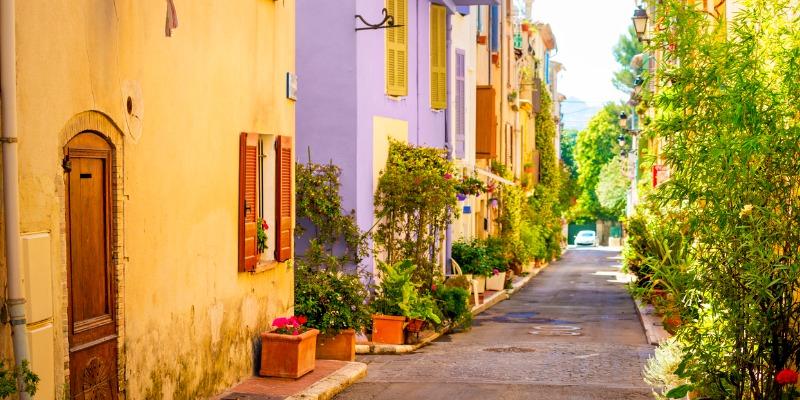
Grasse is the city of perfume. 17 km from Cannes, this inland Côte d'Azur town is languidly nestled at the foot of the Provençal Alps.
The town owes its name to the oily soil that has long favoured the cultivation of flowers. A city of art and history dating back to the 7th century, recently recognised by Unesco for its expertise in perfumery, Grasse today is recognised worldwide as the capital of flowers and perfumes.
So lose yourself in old Grasse, a medieval town with a southern character and ochre hue. Then visit the Musée International de la Parfumerie where you will discover 4000 years of perfumery history, the famous maisons and the perfumer's trade.
The mystery of Coco Chanel's N°5 and other famous fragrances will be revealed. In a historic perfumery in Grasse, you can then create your own personal fragrance and become a nose, like the famous maître parfumeur, including Fragonard, Galimard or Molinard. Finally, set out to discover the beautiful villages around Grasse, including Gourdon, Auribeau, Bas-sur-Loup, Opio, Châteauneuf, Spéracèdes or Cabris.
Forty metres underground, on the other hand, are the caves of Saint-Cézaire. For a bucolic stroll among mimosas, jasmine, iris, violets and roses, go to the Domaine de Manon, 10 minutes from Grasse.
Finally, 45 minutes from Grasse, in Thorenc, is the Réserve Biologique des Monts d'Azur, an exceptional landscape of forests and cliffs where Przewalski's horses, deer, foxes and wild boars live in semi-freedom.
Saint-Raphaël 
Saint-Raphaël is a popular resort on the Côte d'Azur and the ideal starting point for an excursion to the Massif de l'Estérel behind it. 45 km of footpaths and more than 100 km of marked circuits for mountain bikes and horses will take you through the most beautiful landscapes of this volcanic mountain massif overlooking the Mediterranean.
Saint-Raphaël also has a beautiful old town where you can stroll around the flower and vegetable market, the 12th century San Raféu church and the tower from which you can admire a 360° panorama stretching as far as Saint-Tropez and the peaks of the Estérel. The Jardin Bonaparte then is a public park with an exceptional view over the bay and the old port of Saint-Raphaël.
For a swim in the sea, Saint-Raphaël has 36 km of coastline and some 30 wild beaches accessible either by the coastal path or the famous Corniche d'Or. Or take the Sentier du Littoral for a 12 km walk along the sea.
Hyères 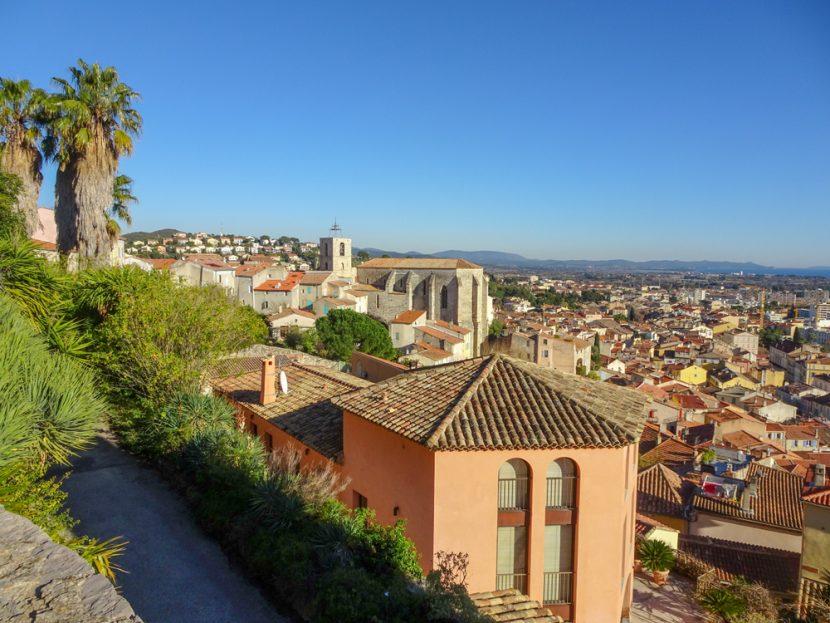
Hyères is a pretty town on the Mediterranean Sea, situated in a beautiful bay from the Giens peninsula to the Fort de Brégançon.
It is a medieval town where you can stroll through its quaint little streets, but also an aristocratic city with its sublime belle époque villas. It is also home to the famous Villa Noailles, which was the haunt of numerous artists such as Giacometti, Man Ray, Cocteau and Dali.
Hyères also boasts beautiful sandy beaches lapped by turquoise waters and offers several seaside routes such as the coastal path of the Giens peninsula. Finally, take a ferry to the island of Porquerolles.
Porquerolles Island 
Porquerolles is a pearl of the Côte d'Azur not to be missed. It is located in front of the bay of Hyères, a short distance from the coast, and is the largest of the Hyères islands: about 7 km long and 2.5 km wide, which can be explored on foot or by bike.
Porquerolles in summer is taken by storm by tourists, so the beaches are overcrowded, but it is worth visiting the island in a day, perhaps during the low season.
The island is a paradise with light sandy beaches and crystal-clear sea, such as the plage du Grand Langoustier, the plage de la Courtade or the plage Notre-Dame. Porquerolles also has a small, lively and colourful village.
54 km of trails, on the other hand, will let you explore the island's wild coastline, dotted with creeks, forts and vineyards. Not to be forgotten, the amazing barefoot museum of contemporary art, the Fondation Carmignac.
Most beautiful beaches on the Côte d'Azur
Agay beach (Frejus)
Plage de TahitiLe (Grimaud)
Le Layet (Lavandou)
Plage des Engraviers (Bandol)
Palm Beach (Cannes)
Sablettes Beach (Menton)
Larvotto Beach (Principality of Monaco)
Baie de la Garoupe (Antibes)
Sainte Marguerite (Pornichet)

What to eat on the French Riviera
The Côte d'Azur's cuisine has a Mediterranean character that reflects its location between the sea and the mountains.
Here are the specialities to taste: anchovies (often served as a puree with capers and olive oil, in beignets or marinated), sardines, beef stew, bourride (white fish such as sea bass, mullet or monkfish steamed, served with a brunoise of vegetables, garlic croutons and a good aïoli), brousse (firm, creamy sheep's cheese) courgettes niçoises (pieces of beef marinated in wine, browned in olive oil, then simmered for hours with bacon, onions, garlic and herbs), estocaficada (cod or haddock, sun-dried and stewed with potatoes, tomatoes, peppers, onions, garlic and olives), pan-bagnat (bread soaked in olive oil and garnished with whatever you want) pissaladière (a speciality of Nice, a kind of bread dough with onions and pissala, a puree of salted anchovies), ratatouille (a dish made with courgettes, aubergines, tomatoes and peppers cooked for a long time in a casserole with garlic and herbes de Provence), porchetta, poutina (fried sardines served in beignets or omelettes), boiled ravioli stuffed with meat or vegetables, salade niçoise (made with raw vegetables such as tomatoes, beans, green peppers, artichokes, anchovy fillets, radishes, as well as boiled eggs and olives), soupe au pistou (vegetable soup with basil pesto and pasta), tapenade (a sauce made with capers, black olives and anchovies and olive oil), aïoli (cold mayonnaise-like sauce).
Each dish will be dressed with olive oil from the Côte d'Azur. Then don't forget to taste the olives; Nice is the kingdom of the caillette, a small black olive renowned throughout the south. Among desserts, try socca (in Nice) or cade provençale (in Toulon), a galette made with chickpea flour, to be eaten hot and well peppered. But also fougasse (a galette flavoured with orange blossom), tourta de blea (a pie made of chopped chard leaves, with sultanas, pine nuts and apple).
To drink, get a rosé from the Côte d'Azur and end the day with a good pastis, the aniseed-flavoured alcoholic drink that tastes of the sun and the south.
The most beautiful villages on the Côte d'Azur
Cagnes sur Mer
Cavalaire-sur-Mer
Gassin
Ramatuelle
Saint Paul de Vence
Bormes-les-Mimosas
Tourrettes-sur-Loup
Le Lavandou
Grasse

Getting to and around the Côte d'Azur
You can reach the French Riviera from Italy by plane, landing at Nice airport, or by train. Otherwise, you can leave from Italy with your own car with which you can then move freely along the Côte d'Azur.
In any case, most cities on the French Riviera are well connected by trains, which can be a convenient way for those who do not like to drive.
When to go to the French Riviera
The climate on the French Riviera is Mediterranean, with mild, relatively wet winters and warm, sunny summers.
The best time to visit the Côte d'Azur is between April and September, which are warm and sunny. If you want to go on a beach holiday, prefer May and June, thus avoiding the crowds of July and August.
In terms of entertainment, the Côte d'Azur offers great events that will make your stay special.
In Cannes there is the Cannes Festival in May, in Nice the famous Carnival in February and the Nice Jazz Festival in July, in Menton the Fête du Citron in February, the Sporting Summer Festival in Monaco in July and August.
But every city on the Côte d'Azur organises numerous festivals, concerts and shows throughout the year, especially in summer.
Map and map
France